
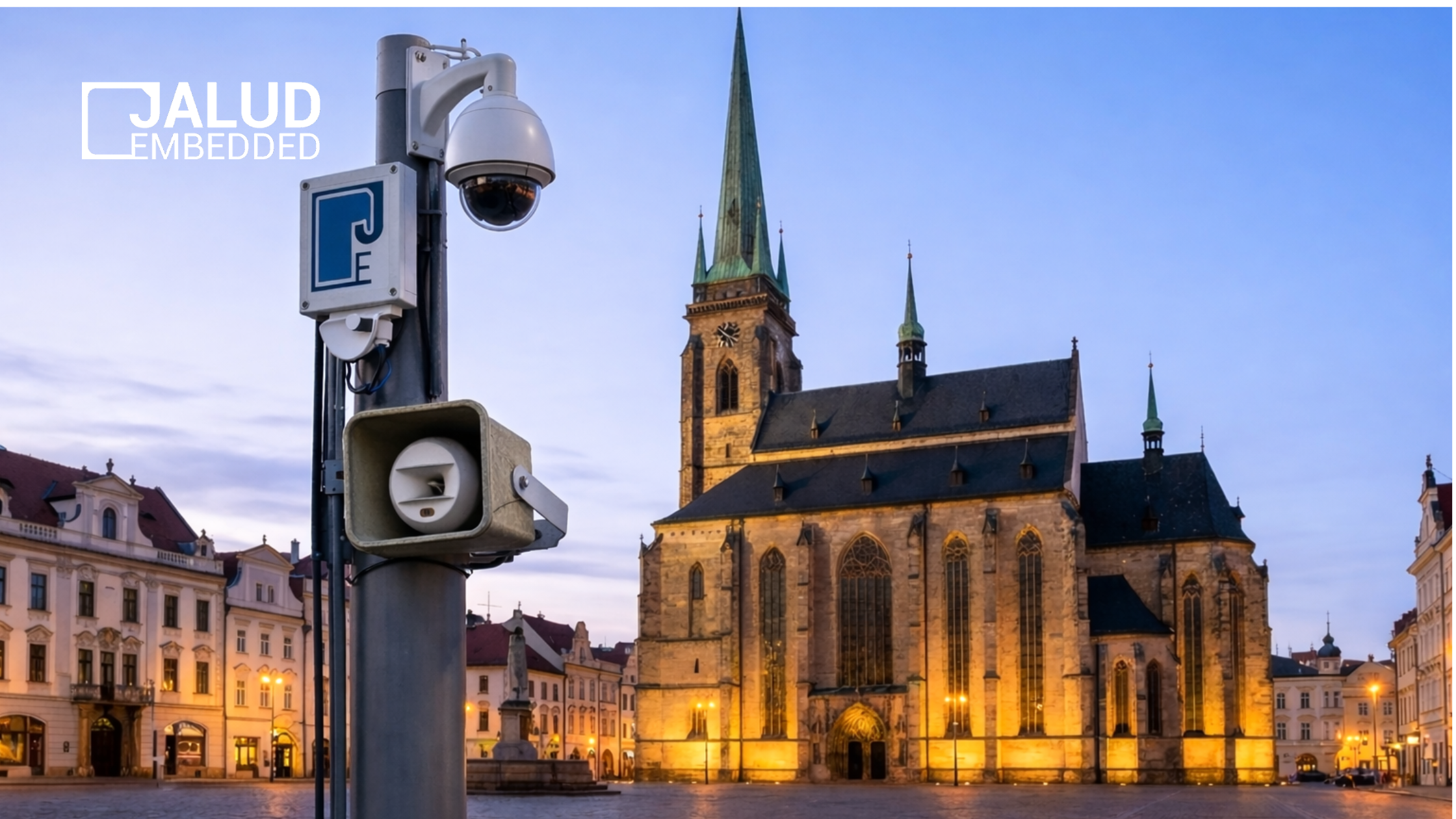
The project in Pilsen confirms that linking video with audio fundamentally boosts security efficiency. The integration of "eyes and ears" increases operator response speed and overall city safety at significantly lower costs.
Quick Facts:
Location: Statutory City of Pilsen, Czech Republic
Scenario: Real-world operations in high-risk urban zones (hotspots)
Events: Dangerous acoustic events in an urban environment
Technology: Sound Event Detector (SED) by JALUD Embedded.
Deployment: 64 SED acoustic detectors integrated into a system of 350 cameras
Context: Blind Spots of Video Surveillance Systems
Urban surveillance in Pilsen utilizes 350 cameras, operated by only four officers per shift. After 20 minutes of monitoring static screens, the human eye naturally loses focus. The main challenge was to streamline operator workflow and activate cameras precisely when something is actually happening within their range. SED acts as a "digital ear," automatically alerting to incidents that the eye might miss.
Implementation and Comparison (2024–2025)
During two years of operation (2024 and 2025), data was collected to validate scientific assumptions regarding AI-driven efficiency:
Active Search: While a camera remains passive without a stimulus, SED acts as an active search tool.
System Learning: Algorithms continuously learn, leading to a steady decline in the system's error rate.
Cognitive Load: Deploying SED eliminates the need to monitor quiet zones; operators only intervene when the system detects an anomaly.
Results That Cannot Be Overlooked
Data analysis from 2024 and 2025 provided clear evidence of the system's benefits:
70% increase in detected offenses thanks to the combination of eyes and ears.
33.6% year-on-year increase in detection efficiency between 2024 and 2025.
Reduced $T_{alert}$ time: Alerts for critical events arrive within seconds of detection.
Reduced error rate: The false alarm rate dropped from 4.9% to a record 2.7%.
High efficiency: One operator can effectively monitor up to 80 SED sensors, compared to a maximum of 4 cameras.
Why It Matters
For modern Smart Cities, the question is not "if," but "when" to connect video with sound. SED acoustic detection does not replace cameras; it acts as their value multiplier. From an economic perspective, implementing this technology is 95% cheaper than increasing personnel to achieve the same level of surveillance. Installation costs at a new location are up to 400x lower for SED than for traditional CCTV systems.
Technological Background
SED – Sound Event Detector (JALUD Embedded s.r.o.).
Coverage: A single sound sensor covers a circular area with a 200m radius (equivalent to 250 cameras).
High Reliability: The system error rate consistently remains below 5%.
Economic Return on Investment (ROI): Operating 60 detectors costs approximately €1,550 per month, compared to €28,300 for additional personnel.
Certification: ISO 9001, ISO 27001, and full GDPR compliance.
Conclusion
The Pilsen solution is fully field-proven and ready for immediate replication in cities of any size. Thanks to the dramatic reduction in response time and unrivaled economic results, it represents the most effective model for today’s Smart Cities.
Read the full study here (PDF)
About JALUD Embedded:
We invite companies, investors, and forward-thinking partners to join us in transforming the future of surveillance and public safety.Together, we can unlock the untapped potential of existing infrastructure, prevent incidents, and build safer communities for everyone.
Let’s create a safer future together.
Contact us:Email: sales [at] jalud-embedded.comPhone: +420 910 128 626 (free of charge)


