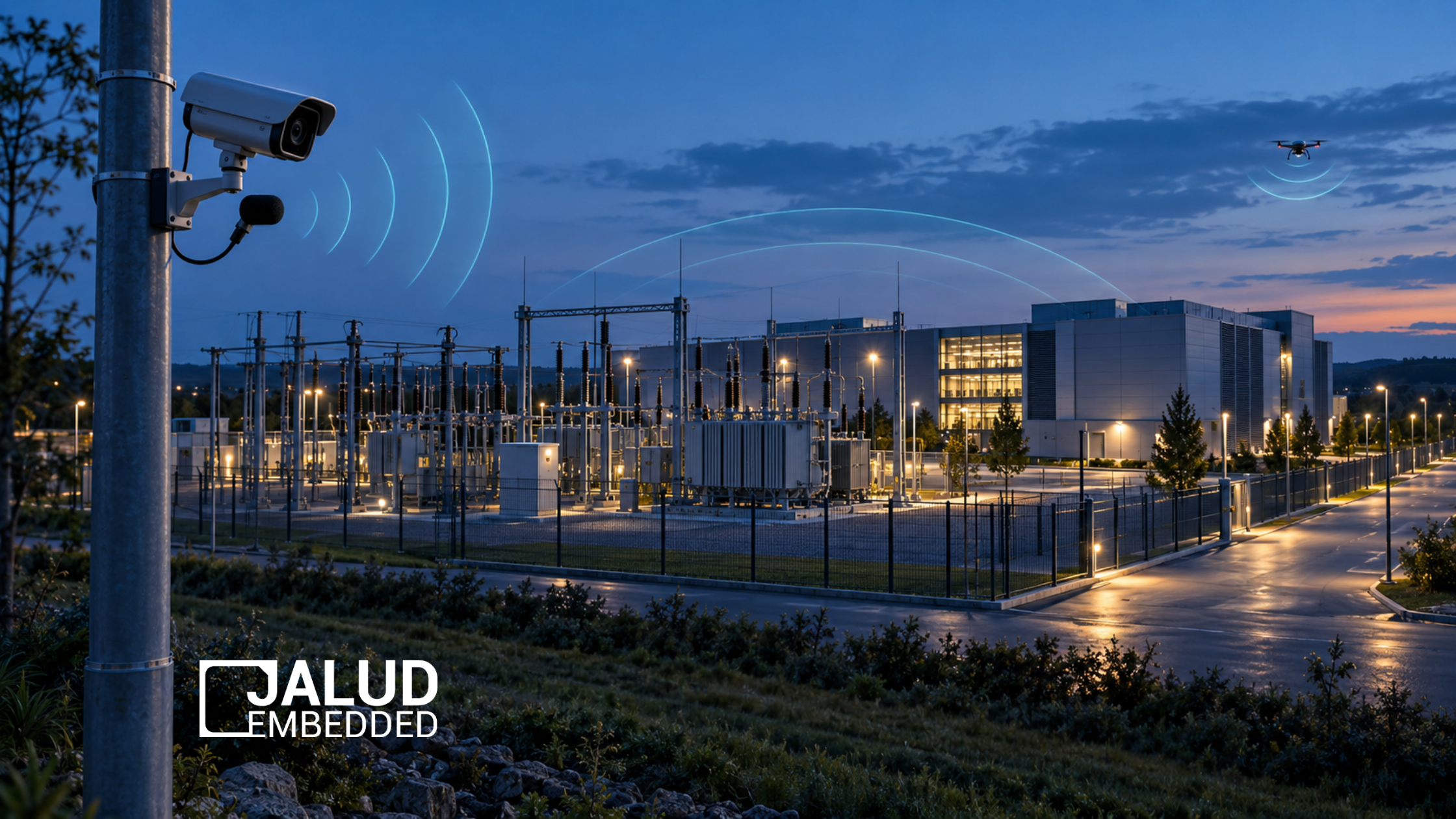
A window breaks behind a technical building. Someone screams near the entrance. The security operator has cameras available but is watching another part of the site. The first warning may only arrive when an employee reports the incident.
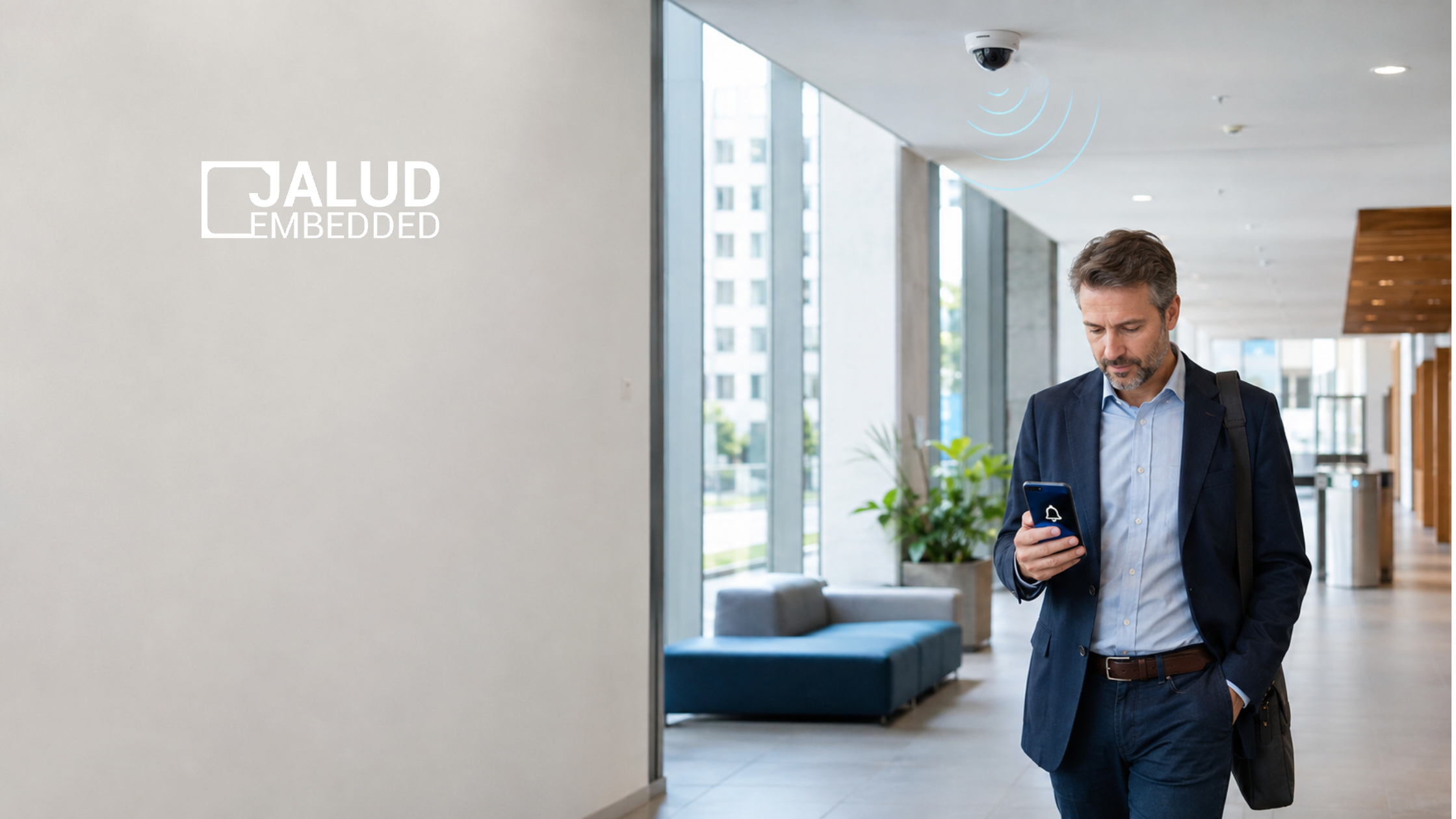
Sound Event Detector by JALUD adds another source of information. It recognises selected sound events and sends an alert to the monitoring system, helping the operator verify what is happening and initiate the appropriate response.
What can SED help identify?
🚨 Threats to people
Gunshots, panic screams and aggression near entrances, reception desks and staff areas.
🔨 Possible intrusion or damage
Breaking glass, grinding tools or spray activity around buildings and perimeter areas. Operators assess each alert in the context of its location, timing and authorised activities.
🛸 Drone activity around the site
Acoustic detection can complement other sensors by identifying UAV sounds. Performance depends on the drone type, ambient noise, weather and microphone placement. SED does not intercept or neutralise drones.
See how detection works with a camera
An example of acoustic detection working with a camera system. Automated camera steering requires the appropriate localisation setup and camera integration.
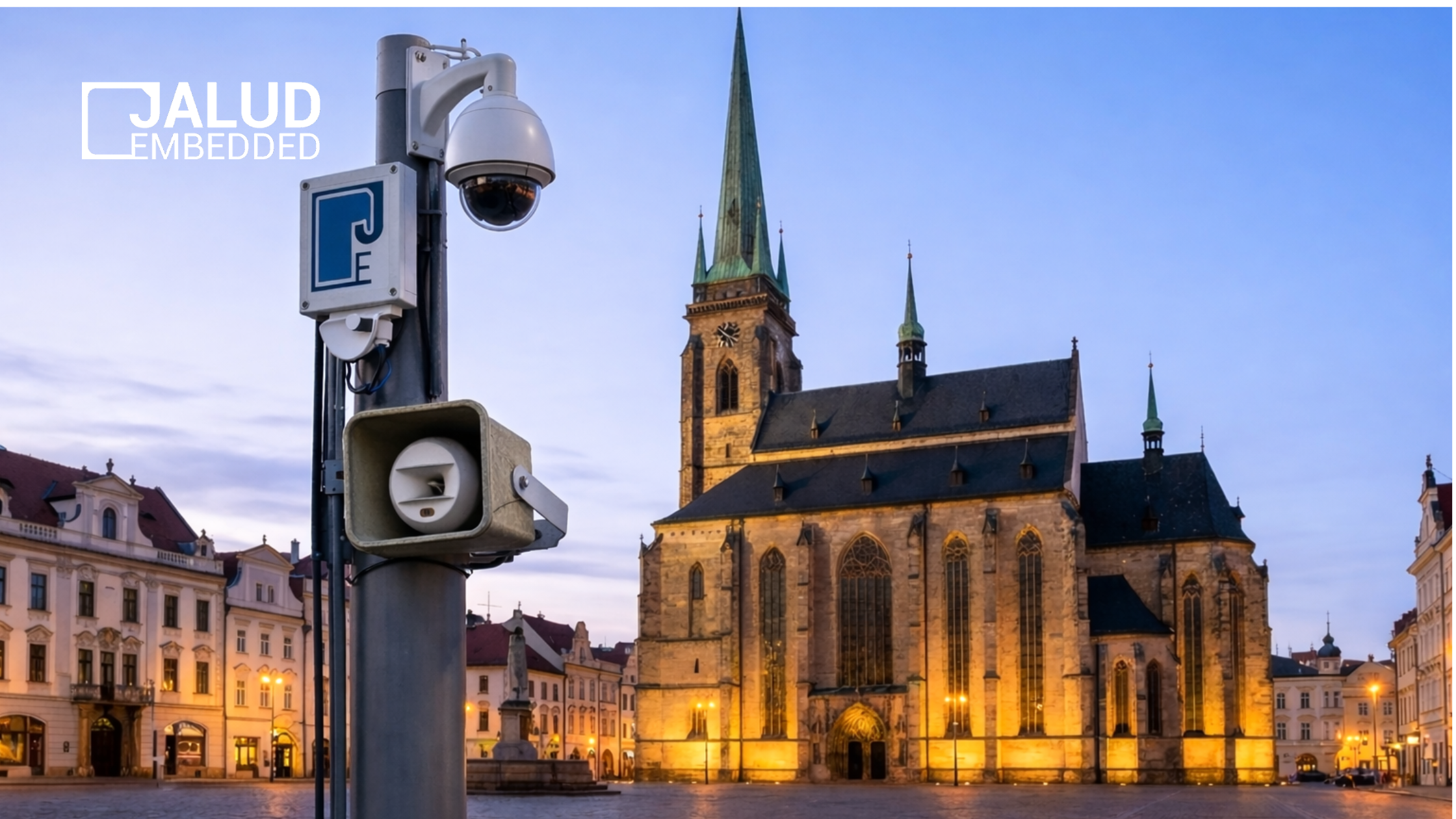
Pilsen: sound detection alongside municipal cameras
In Pilsen, Czech Republic, JALUD sound detectors complement the municipal CCTV system. The deployment illustrates how acoustic detection can become part of an existing monitoring environment.
For critical-infrastructure operators, the practical lesson is the same: connect detection to a monitoring team and a defined response procedure. An alert is most useful when someone can verify it and act.
Read the Pilsen deployment case study →
Airport exercise: how quickly did the alert arrive?
During a simulated security exercise in an administrative building at Václav Havel Airport Prague, researchers compared alerts from JALUD detectors with conventional incident reporting. In one scenario involving aggressive shouting, they recorded:
How could this work at your site?
Illustrative scenario: a window breaks at a technical building during the night.
- Detection: SED recognises the sound of breaking glass.
- Notification: the monitoring centre receives an alert identifying the detection location.
- Verification: the operator checks the situation, for example using an available camera.
- Response: security staff follow the site’s established procedure.
Integration with connected systems can help alerts reach the people responsible for responding.
Explore SED and KISS integration →
How does this support critical-infrastructure resilience?
From risk assessment to practical protection
The EU Critical Entities Resilience Directive (CER) establishes a framework for identified critical entities to assess risks and implement proportionate resilience measures. Articles 12 and 13 address risk assessment, physical protection, incident handling and continuity. Acoustic detection can support selected measures where a relevant threat produces a recognisable sound. Read the CER Directive in English ↗
The complementary NIS2 Directive addresses cybersecurity risk management and incident reporting. SED’s role in this article is physical-event detection; it does not replace the cybersecurity controls required for connected systems. Applicable obligations depend on national implementation and the organisation’s scope. Read the NIS2 Directive in English ↗
Installing SED alone does not establish compliance with either framework. Outside the EU, deployment should follow the relevant national and sector-specific requirements. The installation design should also address audio processing, optional short recordings and access permissions. Edge deployment enables local analysis and the transmission primarily of event information.
Test SED in your own environment
Start with a few locations and clearly defined sound scenarios. A pilot can assess detection in local noise conditions, unwanted alerts and how notifications fit into the security team’s daily work.
Discuss a pilot deployment →Research and further reading
- Accelerating Emergency Response in Airport Environments: An Experimental Study on Intelligent Sound Detection Systems — Smažinka, Ščurek and Hrinko, 2025. Published research on sound detection during a Prague Airport security exercise.
- EU Critical Entities Resilience Directive — Directive (EU) 2022/2557 — Official English text covering the resilience of critical entities.
- NIS2 Directive — Directive (EU) 2022/2555 — Official English text addressing cybersecurity risk management and incident reporting.